

 Hoskin Environmental
 Hoskin Geotechnical
 Hoskin Instrumentation

Armfield CEXC Chemical Reactors Teaching Equipment
One computer-controlled service unit that anchors a complete reaction engineering teaching lab.
The Armfield CEXC is the heart of a modern undergraduate reaction engineering laboratory: a computer-controlled benchtop service unit that supplies the temperature control, feed pumping, instrumentation, and data acquisition shared by an entire family of interchangeable teaching reactors. Buy one CEXC and you can run a CSTR, a tubular reactor, a batch reactor, and flow reactors from the same base, letting students compare reactor behaviour on identical instrumentation. Hoskin Scientific is the authorized Canadian distributor of Armfield.
What Is the Armfield CEXC?
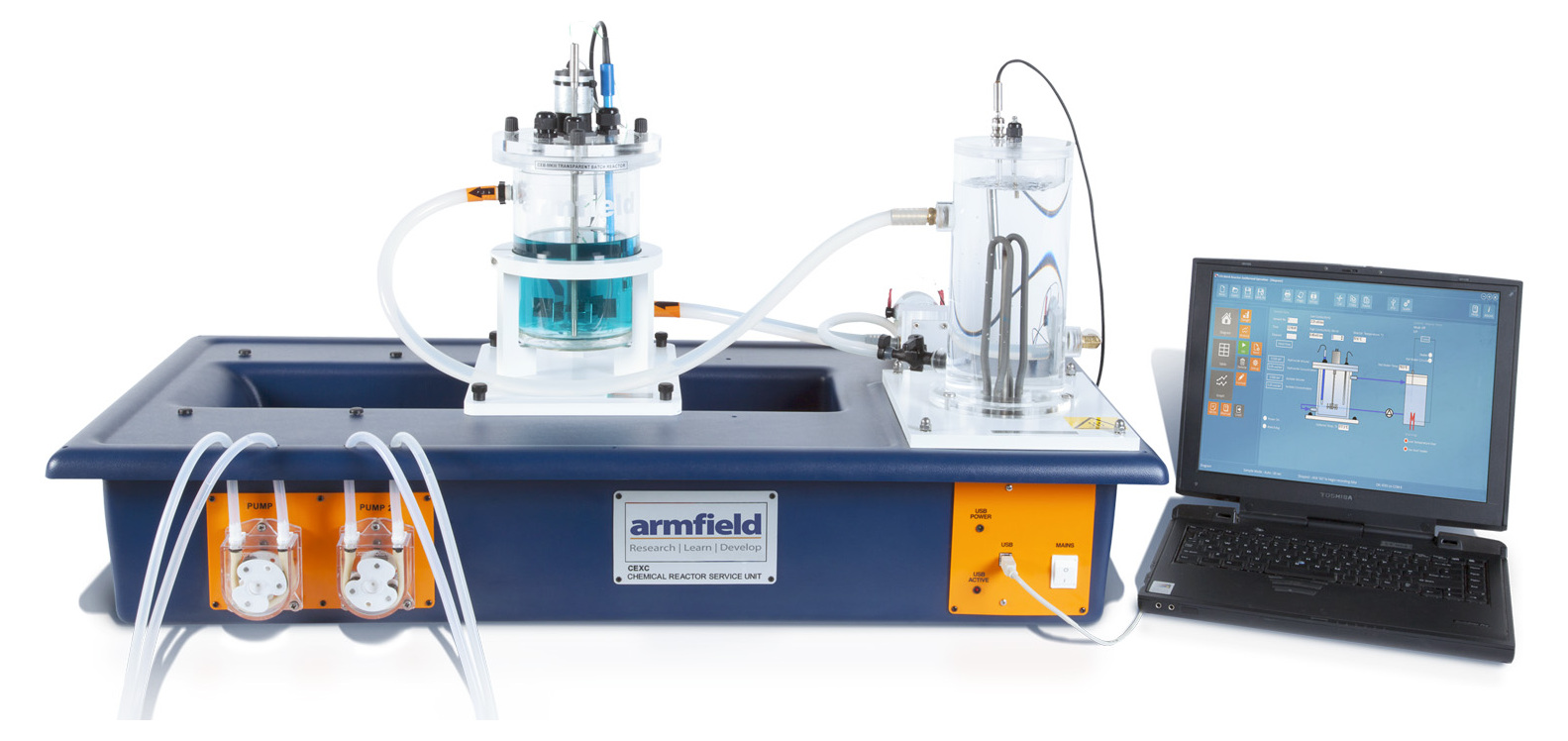
The Armfield CEXC is the Chemical Reactors Teaching Equipment service unit: a computer-controlled benchtop base unit in Armfield's CE-series chemical engineering range. It is the platform that powers a set of interchangeable teaching reactor modules. A common point of confusion is worth clearing up early: the CEXC is a reactor service and instrumentation platform, not a heat exchanger.
Think of the CEXC as the shared backbone of a reaction engineering lab. Rather than buying a separate, fully self-contained rig for each reactor type, a department buys one CEXC service unit and adds the reactor modules it wants to teach. Each module clips onto or stands beside the same base, draws on the same temperature control and pumps, and reports to the same PC software. That makes the CEXC an economical, space-efficient way to give students hands-on experience across the full spectrum of ideal and non-ideal reactors.
The CEXC sits within Hoskin's wider Armfield offering. For the full chemical engineering teaching range, see the Chemical Engineering & Process Control hub, and for the complete portfolio of teaching equipment across disciplines, see the Armfield engineering education pillar.
What the CEXC Service Unit Provides
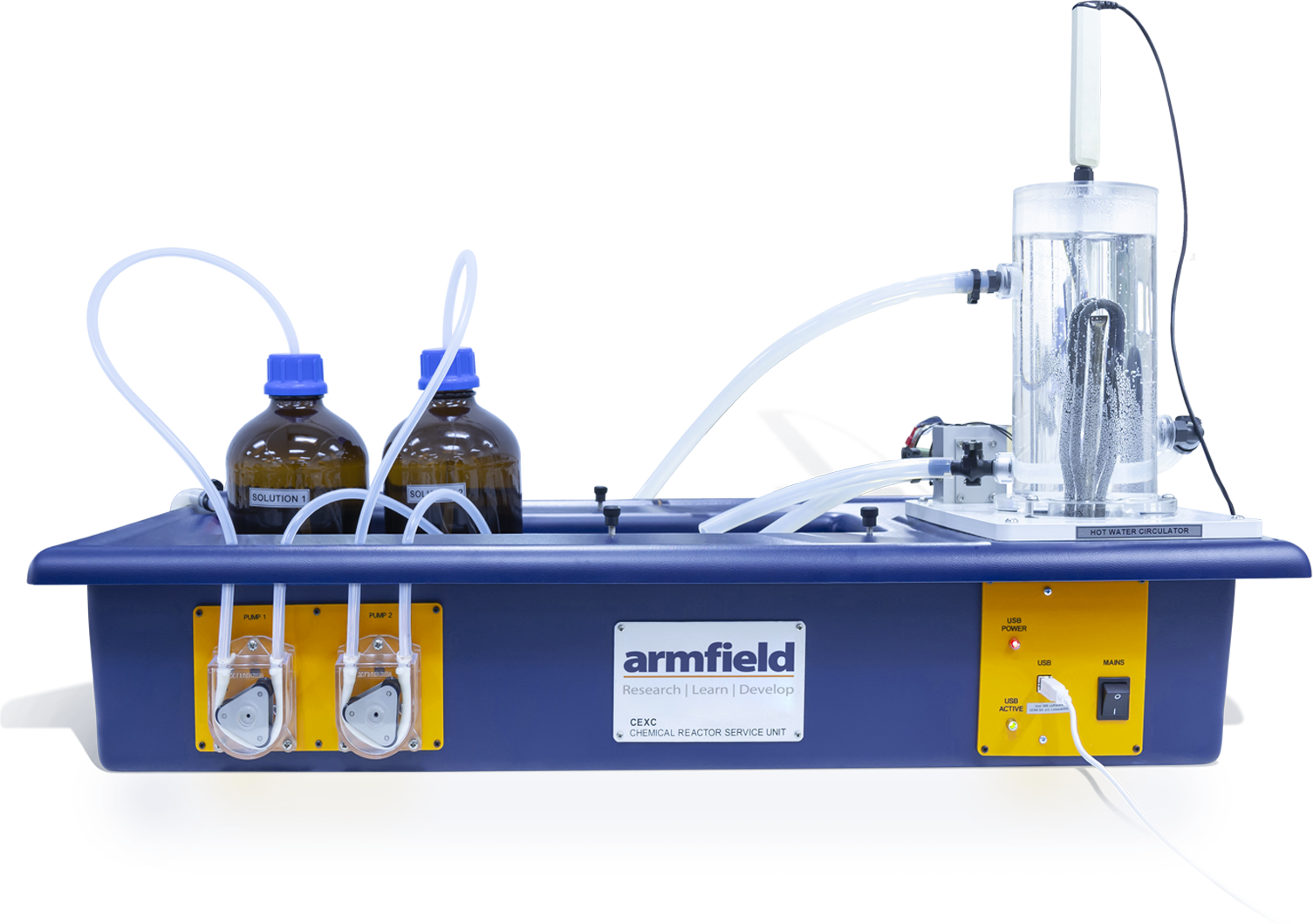
The CEXC delivers every shared service a reactor module needs to run a controlled experiment. Everything is integrated on the one base unit and orchestrated through the PC software.
- PID-controlled hot water re-circulator: maintains reaction temperature for any module that needs heating or temperature regulation.
- Two peristaltic feed pumps: individually variable flow rates of 0 to 140 ml/min, with pump speed set from 0 to 100% in software and predicted flow rates displayed to support calibration.
- Glass feed vessels: hold the reactant streams fed to the reactor module.
- Instrumentation: two K-type thermocouples (hot water bath and reactor), an input for a third user-supplied thermocouple, and a dual-range conductivity sensor for wide-range conversion measurement.
- PC-based control and data acquisition: connects over USB to a Windows PC running Armfield SCADA software.
The software (Windows 7 or later) provides a diagrammatic mimic display of temperatures and flow rates, a PID temperature control loop, pump and stirrer speed control, data logging, graph plotting, multi-run comparison, and export to Microsoft Excel. A separate program is supplied for each reactor module so the on-screen experiment always matches the hardware in front of the student.
The Reactor Modules the CEXC Drives
Five interchangeable reactor modules attach to the one CEXC service unit, covering the reactor archetypes taught in any reaction engineering syllabus. Three of the modules are completely contained on the CEXC base unit; the two flow reactors include floor-standing columns positioned next to the CEXC.
Bench-contained modules
- The CEM-MKII (CSTR), CET-MKII (tubular) and CEB-MKIII (batch) reactors mount on the CEXC base unit itself, keeping a complete experiment within one benchtop footprint.
Floor-standing flow reactors
- The CEY (laminar flow) and CEZ (plug flow) reactors add transparent floor-standing columns alongside the CEXC, ideal for visualising flow behaviour with colour tracers.
Because every module reports to the same instrumentation and software, students can run an experiment on one reactor type and then repeat it on another for a direct, apples-to-apples comparison. See the equipment cards below for a module-by-module summary.
Reactor module line-up
CEM-MKII Continuous Stirred Tank Reactor (CSTR)
A continuously stirred tank reactor module contained on the CEXC base unit. Used to measure reaction rate constants and study steady-state conversion in a well-mixed reactor.
CET-MKII Tubular Reactor
A tubular (plug-flow style) reactor mounted on the CEXC base, ideal for measuring rate constants and comparing tubular behaviour against the stirred tank under matched conditions.
CEB-MKIII Transparent Batch Reactor
A transparent batch reactor contained on the base unit. Supports isothermal saponification runs and, with the optional CW-17, adiabatic studies such as the hydrolysis of acetic anhydride.
CEY Laminar Flow Reactor
A floor-standing transparent column positioned next to the CEXC. Lets students visualise and characterise laminar flow using colour tracers and step or pulse tracer techniques.
CEZ Plug Flow Reactor
A floor-standing transparent plug flow reactor column beside the CEXC. Requires the CW-17 chilled water unit and is used to characterise plug flow and residence time distribution via tracer techniques.
What Students Learn
The CEXC turns reaction engineering theory into measurable laboratory results. A core demonstration is the saponification of ethyl acetate with sodium hydroxide: Armfield developed an algorithm linking the degree of reactant conversion to electrical conductivity, so students can track reaction progress in real time using the dual-range conductivity sensor.
- Reactor comparison: contrast CSTR, tubular, batch, plug flow, and laminar flow behaviour on identical instrumentation.
- Reaction kinetics: measure reaction rate constants in the CSTR and tubular reactors.
- Residence time distribution (RTD): apply step and pulse tracer techniques to characterise mixing and flow.
- Conversion versus temperature: study how reaction temperature drives conversion using the PID-controlled hot water loop.
- Flow characterisation: use colour tracers in the transparent flow reactors to visualise and quantify plug flow and laminar flow.
Reagent consumption is modest, with experiments typically using small reagent quantities per run, which keeps running costs and waste handling manageable for teaching labs.
Isothermal and Adiabatic Operation (CW-17)
The optional CW-17 thermostatically controlled chilled water circulating unit extends the CEXC into below-ambient, isothermal, and adiabatic territory. It is essential for the CEZ plug flow reactor and recommended for isothermal operation of the CEB-MKIII batch reactor.
With the CW-17 in place, the batch reactor can demonstrate adiabatic reactions such as the hydrolysis of acetic anhydride to acetic acid, alongside isothermal saponification runs. This broadens the teaching scope from simple constant-temperature kinetics to the temperature-coupled behaviour students will meet in industrial reactor design.
Specifications and Ordering
The CEXC base unit is specified for single-phase supply, so Canadian buyers should confirm the voltage that matches their lab outlets:
- CEXC-A: 220 to 240V, 1ph, 50Hz, 10A
- CEXC-B: 120V, 1ph, 60Hz, 10A (the common Canadian configuration)
- CEXC-G: 220 to 240V, 1ph, 60Hz, 10A
A Windows PC with two spare USB ports is required to run the control software. The base unit measures 1.00 m long by 0.50 m wide by 0.50 m high, with a gross weight of about 45 kg. Reactor modules and the optional CW-17 are ordered separately to build the configuration your curriculum needs.
CEXC for Canadian University Chemical Engineering Labs
Hoskin Scientific has supplied Canadian science and engineering since 1946 and is the authorized Canadian distributor of Armfield. We support universities from four offices: Coquitlam BC, Oakville ON, Lachine QC, and Edmonton AB, with installation, calibration, training, and bilingual (EN/FR) support.
The CEXC fits naturally into undergraduate reaction engineering and process control courses, where students need to move from textbook reactor models to measured data. Specifying through Hoskin means a Canadian point of contact for the right electrical configuration (the 120V/60Hz CEXC-B is usually the correct choice for Canadian outlets), local lead-time guidance, and ongoing service.
The CEXC is the reactor-engineering anchor of Armfield's chemical engineering range. Explore the full teaching line-up on the Chemical Engineering & Process Control hub, or the complete catalogue on the Armfield engineering education pillar.
Frequently asked questions
What is the Armfield CEXC?
The CEXC is the Chemical Reactors Teaching Equipment service unit: a computer-controlled benchtop base unit that supplies the temperature control, feed pumps, instrumentation, and data acquisition shared by Armfield's interchangeable teaching reactor modules. It is a reactor service platform, not a heat exchanger.
Which reactors does the CEXC drive?
Five interchangeable modules attach to the one CEXC service unit: the CEM-MKII CSTR, the CET-MKII tubular reactor, and the CEB-MKIII transparent batch reactor (all contained on the base unit), plus the floor-standing CEY laminar flow reactor and CEZ plug flow reactor.
What experiments can students run on the CEXC?
Students can measure reaction rate constants, determine residence time distribution using tracer techniques, study conversion versus temperature, and compare CSTR, tubular, batch, plug flow, and laminar flow reactors. A core demonstration is the saponification of ethyl acetate with sodium hydroxide, tracked in real time via electrical conductivity.
Is the CEXC computer-controlled?
Yes. The CEXC connects over USB to a Windows PC (Windows 7 or later). The SCADA software provides a mimic display of temperatures and flow rates, PID temperature control, pump and stirrer speed control, data logging, graph plotting, multi-run comparison, and export to Microsoft Excel, with a separate program supplied for each reactor module.
Do I need the CW-17 chilled water unit?
The optional CW-17 enables below-ambient, isothermal, and adiabatic operation. It is essential for the CEZ plug flow reactor and recommended for isothermal operation of the CEB-MKIII batch reactor. For CSTR, tubular, and basic batch demonstrations it is not required.
How do I get a CEXC quote in Canada?
Hoskin Scientific is the authorized Canadian distributor of Armfield, with offices in Coquitlam BC, Oakville ON, Lachine QC, and Edmonton AB. Contact our education team through the Hoskin contact form at /offices/#formulaire for pricing, the right electrical configuration (the 120V/60Hz CEXC-B suits most Canadian labs), module selection, and installation support.
Specifying a reaction engineering lab?
Hoskin Scientific helps Canadian chemical engineering departments scope the right CEXC configuration, reactor modules, and electrical setup, with installation and ongoing service.
Contact our education team


