

 Hoskin Environmental
 Hoskin Geotechnical
 Hoskin Instrumentation

Statics, Vibrations & Mechanical Engineering
Lab equipment for the fundamental mechanical curriculum.
A guide to teaching statics, strength of materials, free and forced vibration, and balance of rotating masses with Armfield mechanical-engineering teaching apparatus. Built for first- and second-year students who learn best by physically loading a structure and watching it deflect, oscillate, or fail.
What students learn
Statics
Equilibrium of forces, reactions on simply supported beams, two- and three-pin arches, truss analysis.
Strength of materials
Beam deflection, Euler buckling, torsion, stress concentration.
Free vibration
Single- and multi-degree-of-freedom systems, natural frequency, damping ratio.
Forced vibration
Resonance, frequency response, mode shapes on simple structures.
Balancing
Static and dynamic balancing of rotating masses; reduction of vibration in machinery.
Fatigue
Cyclic loading, S-N curves, fatigue failure modes.
The Armfield range
The hub-relevant Armfield equipment Hoskin Scientific supplies and services in Canada:
Beam Bending Apparatus
Simply supported and cantilever beam test rig with instrumentation for measured deflection vs predicted theory.
Truss Demonstrator
Pin-jointed plane truss with strain gauges or proving rings on each member for verification of method-of-joints analysis.
Two- and Three-Pin Arch
Reactions and bending in arch structures under point loads.
Cantilever Deflection
Variable cantilever length with load and dial indicator; Young's modulus determination from deflection.
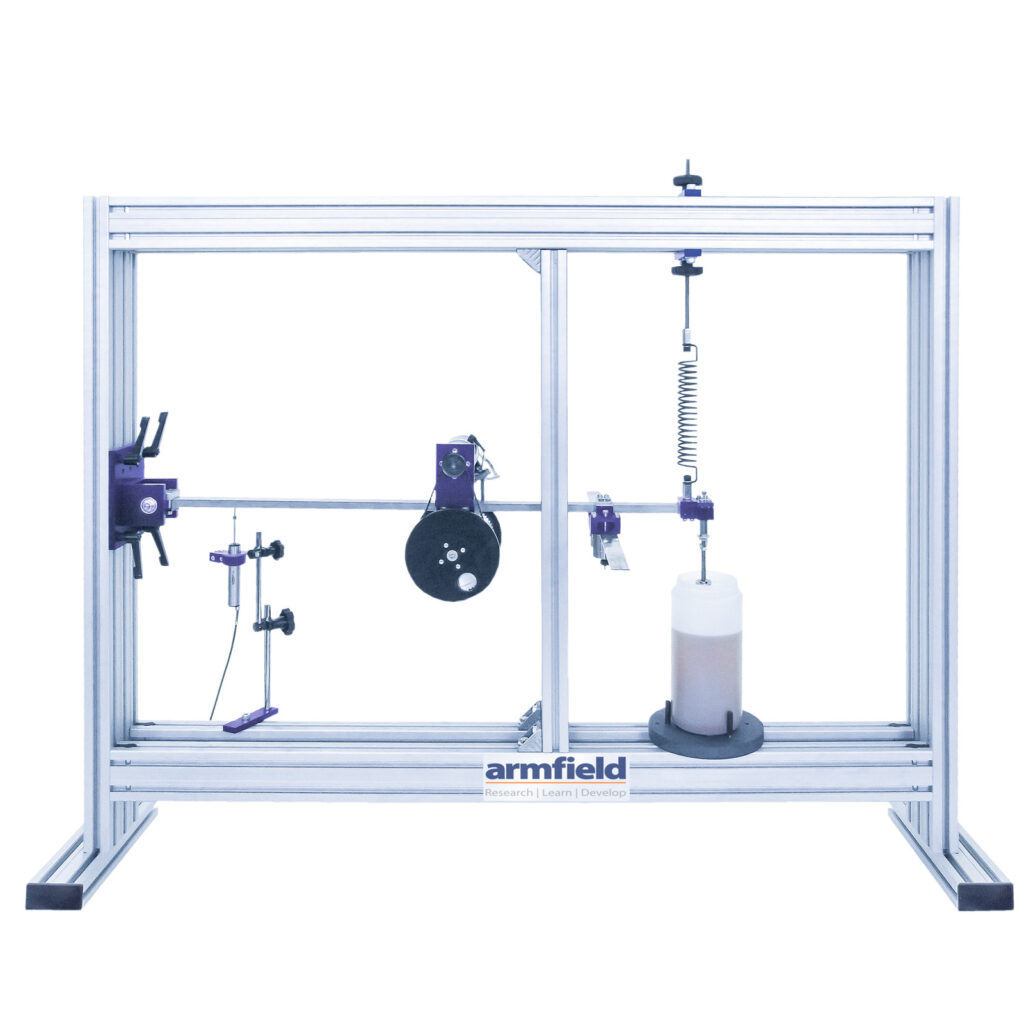
Free & Forced Vibration Apparatus
Mass-spring-damper rig with shaker excitation and accelerometer instrumentation for natural frequency, damping, and resonance experiments.
Balance of Rotating Masses
Multi-mass shaft with movable masses for hands-on static and dynamic balancing.
Torsion Test Apparatus
Shear modulus determination on round bars in elastic and plastic regimes.
Canadian application notes
Mechanical engineering departments at Canadian universities continue to teach the fundamentals of statics and dynamics through physical demonstration, even as simulation tools become more capable. The reason is that students retain the intuition for failure modes and force flow far better when they have personally loaded a beam past yield or watched a balanced shaft fall silent at resonance. Hoskin Scientific has supplied this category of teaching apparatus across Canada for decades.
Why specify through Hoskin Scientific
- Pre-purchase consultation — matching equipment to course learning outcomes and lab utilities.
- Transparent quotation — including landed cost, duty handling, and trade-compliant documentation for grant and tri-council purchasing.
- Installation and commissioning — on-site, by Hoskin technicians familiar with the electrical and water service requirements of teaching labs.
- Service, calibration, and parts — kept in stock to minimise downtime during the academic year.
Explore the six Armfield hubs
Frequently asked questions
What is the most-used apparatus for first-year mechanics courses?
Beam bending and truss demonstrators are the typical entry points for first-year statics and strength-of-materials.
Can students measure damping in vibration experiments?
Yes. Free and forced vibration apparatus includes accelerometer instrumentation and shaker excitation for natural-frequency, damping-ratio, and resonance measurements.
How does the balance-of-rotating-masses apparatus work?
A multi-mass shaft with movable masses lets students perform hands-on static and dynamic balancing experiments.
Is fatigue testing available in the Armfield range?
Yes. Fatigue test apparatus supports cyclic loading and S-N curve experiments at teaching-lab scale.
Get a Quote on Your statics, vibrations, or mechanics Lab
Refurbishing a mechanics teaching lab or adding a vibrations rig to your dynamics course? Our team will help you scope durable, repair-friendly Armfield apparatus that lasts.
Contact our Education team


