

 Hoskin Environmental
 Hoskin Geotechnical
 Hoskin Instrumentation

Concrete Slump Testing: Methods, Equipment and Standards (Canada)
A standards-accurate guide to the concrete slump test under CSA A23.2-5C and ASTM C143.
The concrete slump test is the fastest, most widely used field check of how consistent and workable a batch of fresh concrete is before it goes into a form. On a Canadian jobsite the test is run under CSA A23.2-5C, the equivalent of ASTM C143/C143M, giving the technician an immediate read on whether a ready-mix load meets the specified consistency. This guide covers what the test measures, the governing standards, the step-by-step procedure, the equipment, how to interpret slump values, and how slump fits alongside the other acceptance tests on a project.
What Is a Concrete Slump Test?
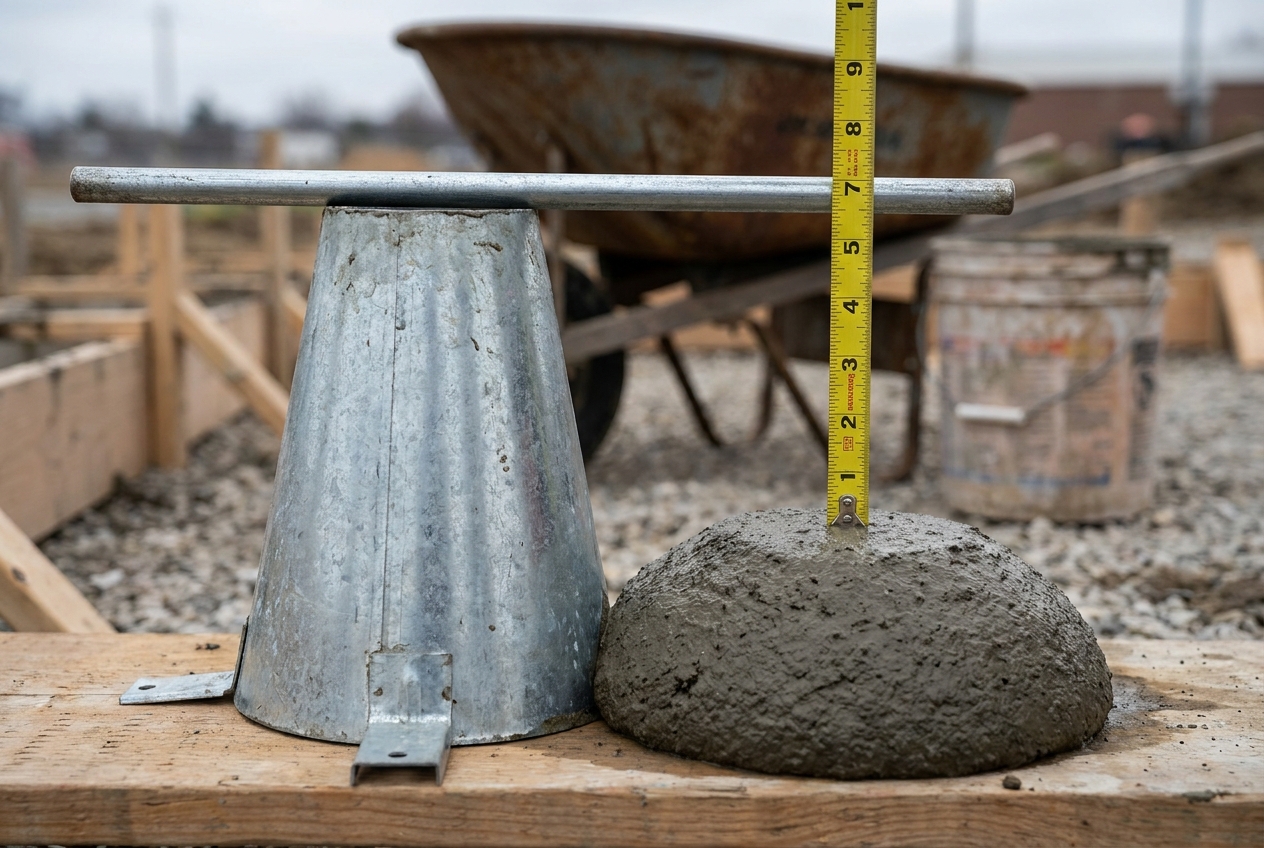
The concrete slump test measures the consistency and workability of fresh hydraulic-cement concrete. In plain terms, it tells you how easily a fresh batch will flow, place, and consolidate before it sets. A technician fills a standard cone-shaped mold with fresh concrete, lifts the mold straight up, and measures how far the unsupported concrete settles, or slumps, downward. That vertical drop, recorded in millimetres, is the slump.
The mold is the Abrams cone, a hollow truncated metal cone with set internal dimensions: 300 mm (12 in) tall, 200 mm (8 in) diameter at the base, and 100 mm (4 in) diameter at the top. A higher slump means a wetter, more fluid mix; a lower slump means a stiffer mix. The test is quick, inexpensive, and repeatable, which is why it remains the standard consistency check on Canadian and North American jobsites.
Slump is an indirect indicator of the water content and workability of the mix. It does not measure strength directly, but it flags batches whose consistency falls outside what was ordered, which often correlates with water that was added on site.
Why Slump Testing Matters
Slump is one of the primary acceptance checks for ready-mixed concrete. A load delivered outside its specified slump range can be rejected before it is placed, which protects the structure and avoids costly remediation later.
The test matters because of the trade-off between workability and strength. Adding water makes concrete easier to place, but it raises the water-cement ratio, which lowers strength and durability. A slump that is higher than ordered is often a sign that water was added to the truck, and that should be investigated before the load is accepted.
- Quality control: Confirms each batch matches the consistency the mix design and the specifier called for.
- Segregation and bleeding: Overly wet mixes can segregate, with coarse aggregate settling and water rising to the surface, weakening the finished surface.
- Water-cement ratio: Unexplained high slump can signal extra water that compromises strength and durability.
- Acceptance or rejection: Slump gives the field a fast, defensible basis to accept or reject a ready-mix load on arrival.
Because slump correlates with the water content that drives strength, it is run in the same workflow as air content testing and the casting of test cylinders for later strength verification.
Slump Testing Standards (ASTM, AASHTO and Canadian CSA)
For a Canadian audience, the governing test method is CSA A23.2-5C, Slump and slump flow of concrete, one of the test methods in the CSA A23.2 series. It sits within the combined concrete materials and methods standard, current edition CSA A23.1:24/A23.2:24, which provincial specifications reference for ready-mix acceptance.
The U.S. equivalent is ASTM C143/C143M-20, Standard Test Method for Slump of Hydraulic-Cement Concrete. The road-sector version is AASHTO T119 (T 119M/T 119). Note that there is no AASHTO T143 for slump; the correct designation is T119.
Two prerequisite and adjacent standards round out the picture:
- ASTM C172/C172M-17 governs sampling freshly mixed concrete, the required step before any slump test.
- ASTM C94/C94M (C94/C94M-21b) is the ready-mixed concrete specification that sets the ordered slump and its acceptance requirements.
For flowable self-consolidating concrete, the standard slump test does not apply. Instead, slump flow is measured under ASTM C1611/C1611M-21, and passing ability is measured with the J-Ring under ASTM C1621/C1621M-17. More on those below.
Slump Test Procedure Step by Step
Run the test on a sample taken per ASTM C172/CSA sampling rules, on a flat, level, rigid, non-absorbent surface. Dampen the cone and place it on the base plate, standing on the foot pieces to hold it down throughout filling.
- Layer 1: Fill the cone to about one-third of its volume (roughly 70 mm deep). Rod this layer uniformly 25 times with the tamping rod, distributing strokes over the cross-section.
- Layer 2: Fill to about two-thirds of the volume (roughly 160 mm). Rod 25 times, allowing the rod to just penetrate about 25 mm (1 in) into the first layer.
- Layer 3: Overfill the cone. Rod 25 times, penetrating about 25 mm into the second layer. Keep an excess of concrete above the rim while rodding.
After rodding the top layer, strike off the surface level with the top of the mold using a screeding and rolling motion of the rod. Clean any spilled concrete from the base around the cone.
Immediately lift the cone straight up, vertically, with no twisting or lateral motion, in a controlled 5 to 12 seconds. Set the inverted cone beside the slumped concrete. Lay the rod across the top of the cone and measure the vertical distance from the underside of the rod down to the displaced original centre of the slumped specimen.
Record the slump to the nearest 5 mm (1/4 in). The whole test, from start of filling to measurement, should be completed within about two and a half minutes.
Slump Test Equipment
The slump test uses a small, standardized kit. Each piece has a defined geometry so results are comparable between operators and sites.
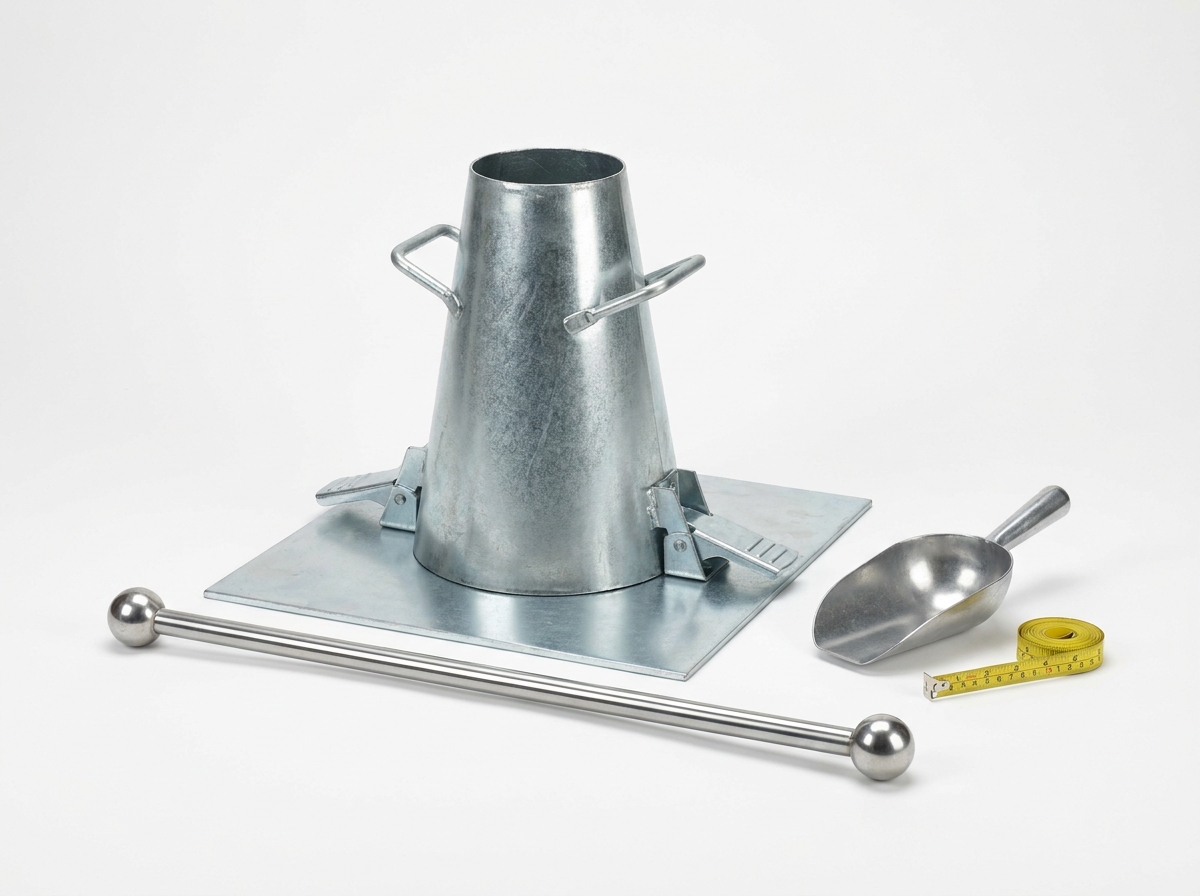
- Slump cone (Abrams cone): Truncated metal cone, 300 mm high, 200 mm base, 100 mm top, with foot pieces and handles.
- Tamping rod: 16 mm (5/8 in) diameter, about 610 mm (24 in) long, round steel with a hemispherical, bullet-nosed tip.
- Base plate or platform: A flat, rigid, non-absorbent plate to set the cone on.
- Measuring rule or tape: Graduated in millimetres to read the slump.
- Scoop and filling funnel: A sample scoop, plus an optional funnel to load the cone cleanly.
Slump is rarely run in isolation. On the same fresh sample, technicians typically verify air content with a pressure-type meter and cast test cylinders for later breaking on a compression testing machine. For broader field-testing programs, see the full range of geotechnical testing equipment.
Slump Values and Workability Classification
Slump values group fresh concrete into broad workability bands. Use these conventional ranges rather than older non-standard labels:
- Low / stiff: about 0 to 25 mm (0 to 1 in).
- Medium: about 50 to 90 mm (2 to 3.5 in).
- High / fluid: more than about 100 mm (4 in).
A simpler practical framing is: stiff below 75 mm (under 3 in), workable around 75 to 150 mm (3 to 6 in), and fluid above 150 mm (over 6 in). For typical general construction such as slabs, beams, and footings, a slump of about 50 to 100 mm (2 to 4 in) is common. Vibrated low-slump mixes of 25 to 75 mm (1 to 3 in) help reduce segregation risk where vibration consolidates the concrete.
True, Shear and Collapse Slump
The shape of the slumped concrete matters as much as the number:
- True slump: The mass settles evenly and keeps its general shape. This is the only valid result.
- Shear slump: The top portion shears off and slips sideways. The result is invalid and the test should be repeated on a fresh sample.
- Collapse slump: The concrete collapses completely, indicating a mix that is too wet or harsh. Retest, and review the mix if it recurs.
CSA Slump Tolerances
Under CSA A23.1, acceptance tolerances around the specified slump are approximately:
- +/-20 mm for specified slumps under 80 mm.
- +/-30 mm for specified slumps of 80 to 180 mm.
- +/-40 mm for specified slumps above 180 mm.
Slump Flow and SCC Testing
Self-consolidating concrete (SCC) is far too fluid for the standard slump test, which would simply collapse. SCC is designed to flow and consolidate under its own weight, so it is measured by spread, not by drop.
The slump-flow test under ASTM C1611/C1611M-21 uses the same cone but measures the final diameter of the concrete patty after the cone is lifted. Typical SCC slump flow ranges from about 455 to 810 mm (18 to 32 in).
Passing ability, the mix's capacity to flow through congested reinforcement without blocking, is measured with the J-Ring test under ASTM C1621/C1621M-17, used together with the C1611 slump-flow cone. The slump-flow / J-Ring method is limited to aggregate up to 25 mm (1 in) nominal maximum size. Comparing the slump flow with and without the J-Ring quantifies how much the reinforcement restricts flow.
Common Issues and Troubleshooting
Most slump problems trace back to either the mix or the operator. Diagnose the cause before accepting or rejecting a load.
- Shear slump: Often a sign of a harsh or coarse mix, or uneven rodding. Repeat the test on a fresh sample. Persistent shear slump suggests a mix-design review.
- Collapse slump: Indicates the mix is too wet, frequently from added water. Retest, and check whether water was added at the site against what was ordered.
- High slump: If it exceeds the specified range and tolerance, investigate added water before placing, since extra water raises the water-cement ratio and lowers strength.
- Low slump: May reflect a stiff mix, water loss, or a long delivery time. Confirm against the specified slump and the age of the batch.
- Operator error: Twisting or lifting the cone too fast or too slow, rodding the wrong number of strokes, or testing on an uneven surface all distort results. Lift vertically in 5 to 12 seconds, rod each layer exactly 25 times, and work on a level, rigid base.
- Timing and temperature: Concrete stiffens over time and faster in heat. Run the slump test promptly after sampling, and note ambient conditions.
Canadian Standards and Specification Context
In Canada, the slump test lives inside the CSA A23.1/A23.2 framework. CSA A23.1 covers materials and construction, CSA A23.2 covers the test methods, and CSA A23.2-5C is the specific slump method. The current combined edition is CSA A23.1:24/A23.2:24.
Provincial transportation and municipal specifications build on CSA. In Ontario, OPSS.PROV 1350 and Toronto TS 1350 reference CSA test methods for ready-mix slump acceptance, and equivalent provincial transportation and municipal specifications across Western Canada, Quebec, and Atlantic Canada do the same. Always confirm the slump and tolerance called out in the project specification.
On test frequency, project quality-control plans commonly call for a slump test with every strength (cylinder) test and with every second air-content test, though the exact frequency is set by the project specification. In practice that means slump, air content, and the casting of test cylinders are run together on the same fresh sample, with the cylinders later broken on a compression testing machine to verify strength.
Hoskin Scientific supports concrete and field-testing programs across the country from four Canadian offices: Coquitlam BC, Oakville ON, Lachine QC, and Edmonton AB, with access to slump, air, and geotechnical testing equipment.
Frequently asked questions
What does a concrete slump test measure?
The slump test measures the consistency and workability of fresh concrete. A technician fills the standard Abrams cone, lifts it, and measures how far the concrete settles in millimetres. Higher slump means a wetter, more workable mix; lower slump means a stiffer mix. It is an indirect indicator of water content, not a direct strength measurement.
What standard governs the slump test in Canada?
In Canada the slump test is run under CSA A23.2-5C, part of the CSA A23.2 test-method series within the current CSA A23.1:24/A23.2:24 edition. The U.S. equivalent is ASTM C143/C143M-20 and the road-sector version is AASHTO T119. There is no AASHTO T143 for slump.
How many times do you rod each layer in a slump test?
The cone is filled in three equal layers and each layer is rodded 25 times with a 16 mm (5/8 in) hemispherical-tipped tamping rod. On the second and third layers the rod should just penetrate about 25 mm into the layer below. The cone is then lifted vertically in 5 to 12 seconds and the slump measured to the nearest 5 mm.
What are the dimensions of a slump cone?
The Abrams slump cone is a truncated metal cone 300 mm (12 in) tall, 200 mm (8 in) in diameter at the base, and 100 mm (4 in) in diameter at the top, fitted with foot pieces and handles.
What is a normal slump value for concrete?
For typical general construction such as slabs, beams, and footings, a slump of about 50 to 100 mm (2 to 4 in) is common. Stiffer vibrated mixes run 25 to 75 mm, while highly workable mixes can exceed 150 mm. The correct target is always the slump specified in the project mix design, within the CSA acceptance tolerance.
Can you slump-test self-consolidating concrete?
No. SCC is too fluid for the standard slump test and would collapse. SCC is measured by slump flow (final spread diameter) under ASTM C1611, typically 455 to 810 mm, with passing ability through reinforcement measured by the J-Ring test under ASTM C1621.
Equipping a concrete testing program?
Hoskin Scientific supplies slump cones, air meters, cylinder molds, and compression machines, with calibration and service from four Canadian offices. Talk to a specialist about your QC setup.
Request a quote


