
 Hoskin Environmental
 Hoskin Geotechnical
 Hoskin Instrumentation

Greenhouse & Controlled Environment Monitoring
Temperature, humidity, VPD, CO2, light and substrate moisture: measured and logged bay by bay.
Greenhouse monitoring instruments: independent sensors, data loggers and wireless networks from Onset, METER, Delta-T and Apogee. Specified, calibrated and serviced in Canada by the team that has done it since 1946. These instruments measure and record; they do not control the house, and the section below says plainly where that line falls.
Ask a Question / Request a Quote
Our team replies within one business day with pricing, lead time and a recommendation.
No obligation. We respond within one business day.
What these instruments do, and what they do not do
Hoskin Scientific supplies measurement. We do not supply greenhouse climate control. It is worth being plain about that before you spend time on a quote.
| What we supply | Sensors, data loggers and wireless monitoring networks that measure and record conditions in the house: air temperature, relative humidity and vapour pressure deficit, CO2, photosynthetically active radiation and daily light integral, substrate water content, electrical conductivity and temperature, leaf wetness and soil temperature. Data is logged, uploaded to the cloud and available for alerting, export and analysis. |
|---|---|
| What we do not supply | We do not sell a greenhouse controller, a climate computer or an automation system. We do not supply vent, heating, screen, fogging, CO2 dosing or irrigation valve control, and our instruments do not actuate equipment. If what you need is a system that opens a vent when the temperature rises, we are not the right supplier and we would rather say so now than after a quote. |
| Where the two meet | Growers who already run a climate computer frequently buy independent monitoring alongside it, to verify what the control system believes, to record conditions where the control system has no sensor, and to keep a traceable, calibrated record for customers, auditors or research. That is the work these instruments are built for. |
If you are not certain which side of that line your problem sits on, send us the crop, the structure and the question you are trying to answer. Our application specialists will tell you which measurement answers it, and will tell you when a monitoring instrument is not the right tool at all.
Greenhouse monitoring sensors, loggers and wireless networks
Everything below is supported, calibrated and serviced in Canada. Follow any instrument for full specifications.
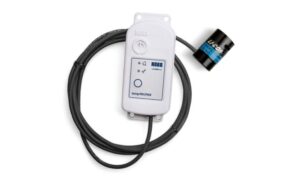
Onset HOBO MX2308 Logger
Temperature, relative humidity and PAR in one Bluetooth logger. A practical way to survey a house, a bench or a trial without committing to a full network first.
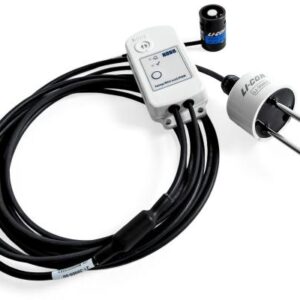
Onset HOBO MX2310 Logger
The MX2308 with a root zone added: air temperature, humidity and PAR plus substrate water content, EC and temperature from one Bluetooth logger, so the canopy and the slab are recorded together.
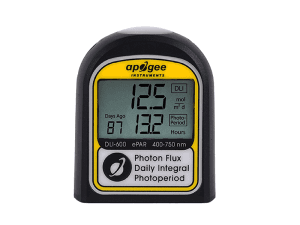
Apogee DLI-500 and DLI-600
Handheld meters that accumulate daily light integral and photoperiod: the DLI-500 for full-spectrum PAR and the DLI-600 for the extended 400–750 nm ePAR range used under LED. Walk the house and record DLI bay by bay.
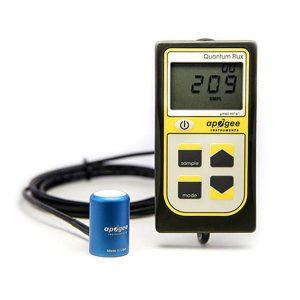
Apogee MQ-500 and MQ-610
Handheld quantum meters for instantaneous PAR at the canopy. The MQ-500 reads full-spectrum 400–700 nm; the MQ-610 reads 380–760 nm ePAR for LED and far-red work.
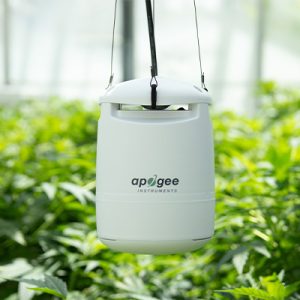
Apogee Guardian SM-500 and SM-600
One monitor for the whole climate: PAR (SM-500) or ePAR (SM-600) with air temperature, humidity, VPD, dew point, CO2 and barometric pressure logged together at plant height.
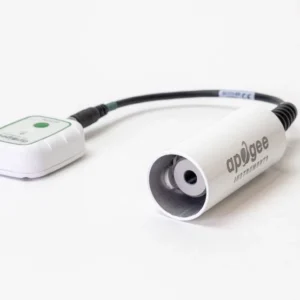
Apogee PI-111 Canopy Temperature Package
SI-111 infrared radiometer with a microCache Bluetooth logger. Non-contact leaf and canopy temperature, the direct measure of crop stress that air temperature only hints at.
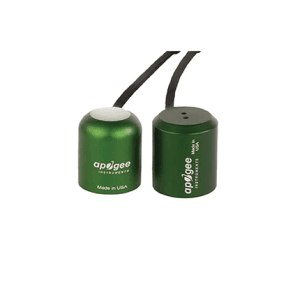
Apogee S2-411-SS and S2-412-SS NDVI Sensors
An upward and downward looking pair that logs Normalized Difference Vegetation Index continuously, tracking canopy greenness and leaf area through the crop cycle rather than by eye.
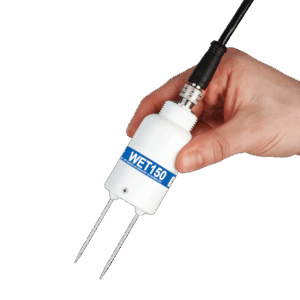
Delta-T WET150
Moisture, EC and temperature in one sensor, handheld or fixed. Widely used in substrate and horticultural production for spot-checking slabs and pots, and logged on the Delta-T GP2 for fixed installations.
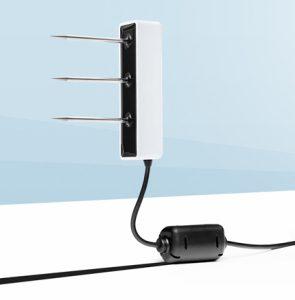
METER TEROS 12
Volumetric water content, temperature and bulk EC in one probe. The research-grade choice for rockwool, coir and potting substrate where irrigation and fertigation decisions depend on the reading.
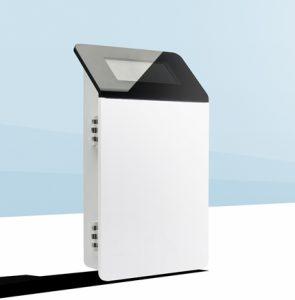
METER ZL6 Advanced Logger
Six-sensor logger with cellular upload, feeding ZENTRA CLOUD charting, threshold alerting, scheduled export and API access. Deploy it and the data arrives without a site visit.
Also available for controlled-environment work: METER ATMOS 14 temperature, humidity and vapour pressure sensors, ATMOS 22 ultrasonic anemometers for airflow studies, PHYTOS 31 leaf wetness sensors and standalone CO2 loggers. Ask us and we will send the current models and specifications for your house.
What is worth measuring in a controlled environment
Most greenhouse monitoring programmes start with temperature and humidity, and most of them find within a season that the parameter actually driving the crop was one of the other five.
| Air temperature, relative humidity and VPD | The base measurement, and the one where sensor placement matters most. Vapour pressure deficit is calculated from temperature and humidity together and is usually a better predictor of transpiration and disease pressure than either on its own. Aspirated or radiation-shielded placement at canopy height, not at the wall. |
|---|---|
| Carbon dioxide | Enrichment is expensive and it stratifies. Logged CO2 at plant height in more than one location tells you what the crop is actually receiving rather than what the injector delivered. CO2 loggers and sensors are available. Aask us for current models and ranges, since the right sensor depends on your enrichment set point. |
| Light: PAR, DLI and photoperiod | Photosynthetically active radiation measured inside the structure, after the glazing, the whitewash, the screens and the dust. Daily light integral accumulates it into the number that supplemental lighting decisions are actually made on, and under LED the extended 400–750 nm ePAR range is increasingly the one being measured. Measure at the canopy, and re-measure after any change to glazing or screens. |
| Substrate water content, EC and temperature | In rockwool, coir, peat or potting mix, water content and pore-water EC together tell you what the root zone is doing between irrigations. This is where fertigation and salinity problems appear first, days before the canopy shows anything. |
| Leaf wetness | Duration of free water on the leaf drives most published disease models. In a greenhouse it is also the fastest way to find out whether your humidity strategy is producing condensation on the crop overnight. METER PHYTOS 31 leaf wetness sensors log onto the same ZL6 as the rest of the site. |
| Uniformity across the house | Every measurement above changes from bay to bay and from gable to gutter. One sensor gives you one number and no idea how representative it is. Distributed wireless nodes give you the spread, which is the number that explains uneven crops. |
How Canadian growers and researchers use independent monitoring
The instruments are the same in every case; what changes is the question the data is bought to answer.
- Verifying the climate computer you already run, a control system acts on the sensors it owns, usually one set per compartment, often years past their last calibration. Independent calibrated loggers placed alongside them tell you whether the set point the computer is holding is the condition the crop is experiencing.
- Mapping the house: temperature, humidity, CO2 and light gradients across a range are usually larger than growers expect. A short survey with distributed loggers finds the cold gable, the dead-air corner and the shaded bay, and pays for itself in one crop.
- Substrate and fertigation management: water content and EC in the slab, logged continuously, show the dry-down between irrigations and the salt accumulation that precedes a problem. It changes irrigation from a schedule into a measurement.
- Vertical farming and indoor production: tier-by-tier PAR, DLI, temperature, humidity and CO2 in a stacked system, where the variation between the top and the bottom tier is the whole question. Compact wireless nodes measure at the canopy rather than in the aisle.
- Research greenhouses and trials: trial work needs traceable, documented environmental data that stands up in a paper or a report. Calibrated instruments, documented calibration and consistent placement across treatments are what make the environmental data usable.
- Records for customers and auditors, a logged, calibrated environmental record answers questions about conditions during a specific crop, batch or shipment. Cloud-hosted data with scheduled export means the record exists without anyone remembering to make it.
Why specify through Hoskin Scientific
Pre-purchase consultation
Our application specialists match the sensor to the measurement and the site before you buy, a recommendation, not a catalogue.
Certified Onset service centre
We are the exclusive certified Canadian service centre for Onset, with calibration and service from four centres in Coquitlam, Oakville, Lachine and Edmonton.
7–10 day turnaround
Standard calibration turnaround from receipt at a Canadian centre, with rush service available for time-critical field programmes.
Service across the season
Long-running programmes depend on instruments staying calibrated season after season. Annual and semi-annual contracts bundle calibration, maintenance and consumables.
Stock in Canada
Stocked items normally ship within 1–3 business days from a Canadian warehouse, with lead times confirmed on every quote.
Related monitoring applications
Frequently asked questions
Do you sell a greenhouse controller or climate computer?
No. Hoskin Scientific supplies monitoring instrumentation - sensors, data loggers and wireless networks that measure and record conditions. We do not sell climate-control systems, and our instruments do not actuate vents, heating, screens, CO2 dosing or irrigation. If you need a control system, a greenhouse controls integrator is the right call. If you need to know what your existing control system is actually delivering to the crop, that is what these instruments are for.
Can I connect these sensors to the climate computer I already have?
It depends on the sensor. METER TEROS and ATMOS sensors are SDI-12 native, and many are also available with Modbus RTU over RS-485 or analog output, so they can be read by a third-party logger, PLC or control system that supports those protocols. Onset HOBOnet is a self-contained wireless network that reports to its own manager and to HOBOlink rather than into a third-party controller. Send us the make and model of the receiving system and we will tell you what will and will not integrate before you order.
What should I monitor first in a greenhouse?
Air temperature and relative humidity at canopy height in more than one location, because that gives you vapour pressure deficit and a first look at uniformity. Add PAR or daily light integral next if lighting or screening decisions are on the table, and substrate water content and EC next if irrigation or fertigation is the problem. CO2 is worth adding as soon as you are enriching, because enrichment is expensive and stratifies badly.
How many sensor points do I need per greenhouse?
Enough to see the gradient. As a working starting point, one node per distinct compartment or bay, plus additional nodes at the ends and gables where the structure is coldest and driest, plus one at the point where the crop is consistently different. A short survey with rented or portable loggers before installing anything permanent is the cheapest way to find out how many fixed points the house actually needs.
Do you calibrate greenhouse sensors in Canada?
Yes. Hoskin Scientific calibrates and services instruments from four Canadian service centres, handled by factory-trained technicians working to the manufacturer's published procedure, and we are the exclusive certified Canadian service centre for Onset. Standard turnaround is 7-10 business days from receipt, and every calibration is documented for audit. Annual or semi-annual service contracts bundle calibration, preventive maintenance and consumables at a predictable cost.
Tell us what you need to measure in the house
Send us the crop, the structure and the question you are trying to answer. We will specify the sensors that answer it, and tell you where a monitoring instrument is not the right tool.
Request a quote →


